Archive for September, 2009

30
Sep

clearOK, I will admit it on this one, there may be a very simple answer on this that I am just not seeing.  So let me know if that’s the case.

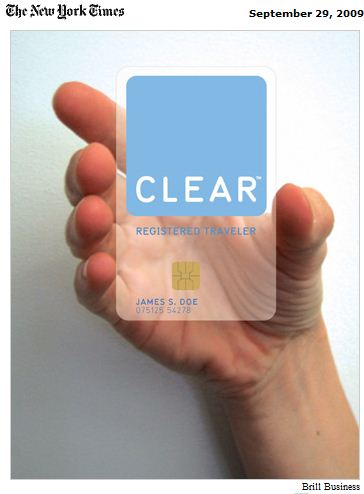
This morning I read an article in The New York Times by Brad Stone ‘Clear’ Security service May Return to Airports.  I did some research on the story (though I will admit it was probably even less research that Dan Rather did on his George Bush story a couple of years ago – that was also in the paper today) and I couldn’t get a straight explanation about what this “Clear” service with its “Verified Identity Pass” actually offers passengers or airports.  Evidently it helps airline passengers spend a lot less time in security lines at the airport for a fee of around $200 per year.

As I read through this article that talked about the fact that “Clear” may come back online after running out of cash earlier in the year, I started to try to piece together exactly what is going on with airport security.  What outcome is TSA (which stands for Transportation Security Administration – not “taking scissors away” as some joke) trying to accomplish?  What may seem obvious to you is not obvious to me.  Is the goal to test whether passengers are a threat the day of the flight, or is the goal slightly different from that?

In the book Rethink I examine the flight check in process and suggest that there are really three outcomes that need to be achieved at that stage of the process:

1) Confirm Reservation

2) Complete Survey

3) Document Checked Baggage (if applicable)

There are two basic points in breaking up those pieces, and they are that the airlines have figured out that it doesn’t matter who is doing the work (employee or passenger), where it happens (counter, kiosk, web), or what the technology is that’s used to accomplish those three outcomes, but more importantly for the airlines, instead of looking for airline industry best practices for this set of “whats” or outcomes, seeing that none of the three things necessarily has anything to do with the airline industry, the opportunity to look for best practices in other industries that do those three things really opens the door of possibilities for improvement (increasing the need to be specific and measured about why you would change it and how you define success).

OK, that’s check in.  Now on to security.  What is really going on there?  Is it to test that each passenger does not pose a potential threat to the flight/airport today, or is it a broader test of whether this person is generally a threat?  Stone’s article talks about Clear customers having to submit to fingerprinting and iris scanning, but that sounds more like identity testing and today whether people use their driver’s license or a passport, that’s the least invasive, fastest part of the current process.  That’s the first thing I got confused about.

The implication is that Clear customers get to shoot to the front of the line like airline employees and first class (and mile plan elite) passengers.  I understand the airline employees getting to cut the line, but I haven’t really understood why first class passengers get to cut the line.  First class passengers are actually the highest risk of the bunch since they are in a closed off section right next to the pilot’s cabin.  Mile plan people make more sense to me because they fly a lot and they are most familiar with the process so they are probably fast.

Assuming the Clear people still have to take their shoes off and use the quart size zip top bag with nothing over three ounces and go through the X-ray (please tell me if I am wrong about that), then the $200 annual fee is really just a line cutting tax and the iris/finger printing thing is really just superfluous?  If the actual security testing of these people is less rigorous than the rest of us, then someone has decided that the goal of security is a test of who is a threat to the flight/airport in general and that there’s no need for more rigorous testing the day of the flight.  That seems strange to me.

What am I missing on this?

-Ric
Category : Uncategorized | Blog
28
Sep

The September Harvard Business Review includes an article “What Service Customers Really Want” by Dave Dougherty and Ajay Murthy.customer

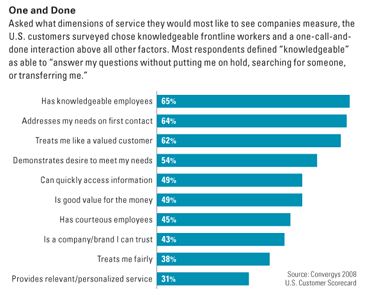
Read it for yourself, but the basic premise is that you need to delight your customers with the customer service you provide.  There’s a interesting graph illustrating that what we customers want, more than anything, is to speak with someone knowledgeable and they want their issue resolved on the first call. If we, the customer don’t receive this level of service, we will take our business elsewhere.

But I caution you before heeding this seemingly sage guidance.

In my experience, this guidance holds in only a certain percentage of cases, and if you are in a business that falls outside of this customer satisfaction Venn diagram, then you are wasting time and money.

In the book Rethink I say that once you understand the “whats” that make up your business (before looking at “how” they are done), you then mark which are high and low value, and then mark how they are performing.  In my definition business value of any given block of work is the combination of three things:

1) Does it relate to your brand or identity in terms of why customers, partners, or employees do business with you or work with you?

2) Does it have a direct connection to a key performance indicator of the organization?

3) Is there value in improving the performance of that block of work?

I offer several examples of common blocks of work that fail all three tests, including Pay Employees, and then ask people to apply the same work they do in their department, division, or the organization as a whole.

While I agree 100% that you have to stay in close touch with what’s most important to your customer, I reject the notion that customer service is always high on the list. I can think of lots of companies that I don’t like, but I still buy their products or services because they are the best at meeting whatever need I have, whether the primary measure of satisfaction is quality, price, timing, or something else.  Remember the “soup nazi” from the TV show Seinfeld?  People didn’t like him and he didn’t like his customers, but his soup as so great people put up with him (and that character was based on a real soup chef in NewYork).

There are plenty of examples of this in business, but one directly from the pages of Rethink is the online bank ING DIRECT.  Here’s a bank that focuses on delivering very high interest rates to the savings accounts of their customers.  They are so focused on this as their #1 goal, they cut way back on the level of phone support they offer their customers.  They don’t care if a customer has a bad experience on phone support because that’s not what they are “selling” to the customer.  While that is an example of an organization that wants you to take your business elsewhere if you are unhappy about the level of customer service.

If I buy a Snickers candy bar and it tastes bad or the wrapper didn’t seal the product correctly, will I expect great customer service from the makers of Snickers? Nope, and I bet they don’t spend a lot of money on that – Snickers is a well established product and for a product that’s usually less than a dollar, I don’t think anyone in their right mind would expect to be delighted with their customer service.

From there we go to amazon.com, where I may search for a new pair of shoes and I may want the best price for a big name – in that case price is my number one goal, so if I have a bad experience with the product, I am not going to expect amazon.com to delight me with their customer service because I put price ahead of everything else in terms of what I as the customer valued in that transaction.

So if you are thinking about beefing up your customer service because of this article, be sure you are really in touch with the value proposition you have with your customers, or you might do yourself a huge dis-service.

-Ric

Category : Uncategorized | Blog
21
Sep

amazonA recent article in the New York Times “Can Amazon Be Wal-Mart On The Web?” by Brad Stone talked about how big and successful Amazon has become, even thriving in the downturn.  Stone talks about the 605,000 square foot warehouse in Phoenix as just one of 25 such warehouses Amazon has, and talks about their pricing and how they don’t store similar things together for efficiency and accuracy reasons.  Stone also talks about the fact that Amazon gets “negative working capital” which means they sell many of their goods before they have to pay for them, which he points out is unusual outside of the grocery store business.

While I don’t dispute any of the facts in Stone’s article, I think his analogy, and his article, miss the point of where Amazon is going.

I often compare Sam’s Club and Costco as two companies that are in the same basic industry (so “what” they are doing is nearly identical) with radically different operating models (Sam’s Club makes money selling its products, Costco does not – they make their money on their membership dues).  The point is that comparing Sam’s Club and Costco is risky because they have such different success metrics in different parts of their businesses.  Sam’s Club is a traditional retail operation in the retail industry, while Costco is really a membership business operating in the retail industry.

It’s an even worse analogy to compare Wal-Mart and Amazon.  Yes, they are in fact both selling retail products, and probably a lot of the same products.  Wal-Mart is absolutely a retailer, in many ways like Sam’s Club, but Amazon doesn’t view, or describe, themselves as a retailer any longer.  They are a software company.  Just ask them (or read the 11th chapter of the book Rethink).

Amazon is working (and succeeding) to be the backbone of all internet transactions.  Their software enables merchants to leverage all of their pricing, shipping, and billing.  Amazon as a giant retailer is the tip of the iceberg in terms of what they are really doing.  If you start to compare Amazon with other software companies, the magnitude of their success is a much, much bigger story.

As an aside, Stone has some examples of companies that are suffering because of Amazon’s dominance, like Lombardi Sports in San Francisco.  Again, I think that is a mis-characterization of what’s going on.  It’s less that Amazon is hurting Lombardi, it’s that customers are going to the internet to buy more of their goods and in part because Lombardi has neglected its web site, that’s why they are suffering (that’s not the only reason).    Internet transactions will continue to be a larger and larger percentage of all transactions, and merchants that don’t figure that out are the modern day dinosaurs.

One of the key points of the book Rethink is that you have to maintain alignment between what your customer wants and what they value, with your value proposition.  Amazon isn’t the bad guy here, they are actually the good guy, enabling many of the little guy merchants make this shift to stay aligned with their customers.

-Ric

P.S. This is another great example of the issue I raised in a recent blog about the Hedgehog Concept in Good to Great by Jim Collins.  While there are several parts to the Amazon business, it’s basically a software business and a retail business.  At first the retail business was their Hedgehog (the intersection of what they can be best in the world at, what they are most passionate about, and what drives their economic engine), but now it’s their software business.  So now that the retail business isn’t their Hedgehog, does that mean they cease to invest in it?  Of course not, but you need to read Rethink for prescriptive guidance on how to tackle the tension of these two different businesses that can be competing for the same investment dollars.

Category : Uncategorized | Blog
15
Sep

fassToday Google launched a news service called Fastflip and you can access it by going to http://fastflip.googlelabs.com/

Fastflip is a news site that acknowledges that reading the news online is a far worse and slower experience than reading an actual printed copy of what you want, be it People Magazine, Sports Illustrated, or the New York Times.  I read the New York Times every morning, and having the ability to scan the page and quickly look for interesting articles is hard to reproduce online partly because much of what paper readers read isn’t the headlines, it’s the articles we spy on the same page as another article.

Ironically, I read about Fastflip in the printed copy of the paper, and then went out to the site to have a look.

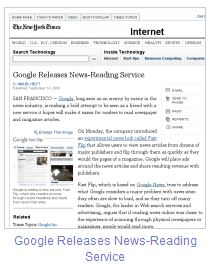
nytI will give Google credit for realizing that news is not one-size-fits-all, and they do allow the reader to select the type of news they want, like sections of a newspaper, from sports, to business, to entertainment, and headlines.  They also allow you to select your source.  So I clicked on the New York Times and saw that they just had thumbnail pictures of all of the articles.  Once at source I didn’t get the ability to choose sections, which is a big mistake.  The picture of the article about Fastflip is to the right.    The image is so small I can’t tell what it is.  I am able to read the title of the article at the bottom, but barely.    Scanning the printed version is still ten times better than this first effort.

I suspect that Google is trying to strike some balance between the old fashioned paper readers like me and the YouTube generation (the Fastflip layout reminds me more of the YouTube layout than a paper, with most popular articles at the top, followed by sections), but in an effort to seemingly please everyone, my guess is that this will please few.

So while I applaud Google’s appreciation for the problem space in terms of “how” people consume news online, this needs some further rethinking.

-Ric

Category : Uncategorized | Blog
8
Sep

secondThis is short post about something that was bouncing around in my head over the weekend that borders on “how” trap humor – but my curiosity is genuine.

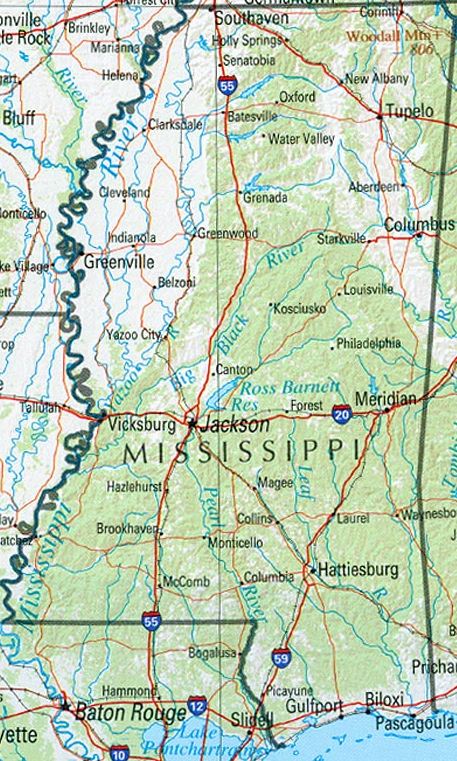
As children most of us were taught that it takes one second for the typical person, speaking at typical speed to say the word “Mississippi.”  It must actually be a little less, because we still have time to say the number we are on “one Mississippi, two Mississippi” and so on.  Though crude, it has endured as a method for “how” to tell the amount of time passing when we don’t need to be perfectly precise (we have the atomic clock for that).  Very handy.

So this weekend for whatever reason, I wondered what people in other countries, particularly places that don’t speak English, how they count seconds?

I don’t think they use Mississippi.  Do they?

Let me know if you know.

-Ric

Category : Uncategorized | Blog
8
Sep

In the book Rethink I spent a lot of time discussing the importance of being really good at delivering what your customer values, and really ignoring or not caring about the parts that the customer doesn’t value (or won’t cause your customer to take their business elsewhere).

I use the example of the cable company that has horrible customer service, we have essentially come to expect it, and most of us don’t call or cable company very often so even though we have a bad experience 100% of the time, it’s usually not enough to cause us to cancel our cable subscription and move to another provider (in part because we expect the same crummy customer service from the next provider).  But there is intelligence in there.  If a necessary service is applied uniformly across an industry (that is, “how” they provide customer service in this case), then there is no differentiation in that area.   One might argue that if one of the cable companies invested to provide world class customer service that they would get all of the customers to rush to them, but I doubt it, since that’s not the most valuable thing people go to them for – it’s the cable.

air1So when I read the article New Aerial Irritant: No Items in Seat Back, by Joe Sharkey in the New York Times, while I agreed with the specific point, I thought Sharkey missed the bigger problem with air travel these days.

For most of us, there are probably only a handful of things that heavily influence our decision with respect to which airline, and which flight, to select.  Price, timing, and frequent flier miles are probably the top three if I had to guess, and whatever is fourth is a distant fourth.  Quality isn’t really a differentiator, food isn’t any more (it used to be for Alaska Airlines), we don’t care about the check in process, luggage isn’t handled any better or any worse than anyone, all of the seats are too tiny, and there’s always a competition for space in the overhead compartments.  So why is travel such a pain?  Because “how” everyone does all of these things is different.  Even TSA (the security people) apply security standards differently in different airports (both the rigor of the use of X-rays and the application of the four ounce rule – get a scale), just as Sharkey points out that different airlines enforce this (annoying) rule about not allowing us to put anything in seat backs, differently.

Especially for things I could not care less about, it is a pain to have to figure out “how” the airline du jour is going to handle things on that day, what I am going to get scolded for, what trick I don’t know about, etc.  That really makes travel a pain and I wish the airlines would figure out a way to standardize “how” they do the stuff that we don’t care about.  I expect that would also make the flight attendants less hostile.

-Ric

P.S. And airlines – when it comes to “how” you board flights, when the flight is really full, please don’t announce that to the waiting area, it only makes things worse – people act as though they aren’t going to get a seat and rush to the door.

Category : Uncategorized | Blog
4
Sep

When I talk with people about favorite books, it’s very common to hear about Good to Great by Jim Collins.  There’s no question there is some great thinking in that work.

1_hedgeSpecifically his Hedgehog Concept, where he instructs us to emphasize the work that sits at the intersection of “what you are deeply passionate about”, “what you can be best in the world at,” and “what drives your economic engine” – and that’s a great way to help organizations really identify what really matters most.  Too often organizations have the attitude that “everything matters” which spreads efforts too thin and it’s no surprise they never rise to the level of greatness Collins talks about.

But in the hundreds of pages that make up this book, Collins neglects to provide guidance on what to do about the other six sections of this Venn diagram.  What about things “you are deeply passionate about” that intersect with “what drives your economic engine”?  Or things that just “drive your economic engine” and don’t touch the other two circles?

My basic point here is that a company is made up of many moving parts, and while it is enormously helpful to have a construct such as the Hedgehog Concept to help us get to what’s the #1 most important set of things, organizations still have to make investments, and especially now, investment tradeoffs, in some of the different parts.

1_conI can name examples of companies that have had to face tradeoffs in each of the six other segments of this diagram, and if you are interested, I would be happy to provide you with that analysis.  For now I will just give you an example of a company called Concur Technologies, and they were very clear about what their Hedgehog was.  Concur Technologies makes software that helps organizations track and manage expense reports and they want people to access that software via the internet as a Cloud service.  That’s what they wanted to be in that middle section of their Venn diagram.  But there was a problem.  The internet access version of their product was not driving their economic engine.  The product that people bought and installed on their own computers (so-called licensed software) was what was driving their economic engine.  They could be best in the world at that, but they were less passionate about it than the internet access version.  So should they stop investing in their licensed software business?  Of course not.  But given finite resources, how should they make investment tradeoff decisions?  They didn’t want to under invest in the licensed software business since that was driving their economic engine, but they also didn’t want to be too timid about investing in the cloud service that was their Hedgehog.  I am not going to suggest that there is an “easy” button to answer this.

1_novenn

What I will say is that with the heat mapping diagrams that are built through the ideas in the Rethink book, people are better able to be objective and very specific, at a more tactical level about what is most and least valuable to the organization, how those things are performing, and which specific changes will cause the overall organization to perform better.  They serve as a compelling visual business case to support, or revisit investment decisions when difficult tradeoffs must be made.

Heat maps are an excellent complement to the Hedgehog.

-Ric

Category : Uncategorized | Blog
1
Sep

Here is the link to the interview Robert Morris conducted with Ric Merrifield.

And here is the excerpt on that page:

Merrifield spent nearly 15 years in various consulting roles helping organizations define and achieve their goals. Since joining Microsoft, Merrifield has spent more than 10,000 hours as a business architect and has filed twelve patent applications, all of which share the same goal: to help companies rethink their operating models and get out of the “how” trap described in the pages of his book, Rethink: A Business Manifesto for Cutting Costs and Boosting Innovation. Merrifield is also a co-author of The Next Revolution in Productivity, an article that appeared in the June 2008 issue of Harvard Business Review, which focuses on case studies that highlight needs of the organization and the opportunity to rethink business operating models before making major technology changes. Merrifield is an alumnus of Lakeside School in Seattle and Georgetown University in Washington, D.C.

Here is an excerpt from my interview of Merrifield. The complete interview is also available.

Morris: Most change initiatives fail and several fail because of cultural barriers that could not be overcome. James O’Toole suggests they are the result of “the ideology of comfort and the tyranny of custom.” In your opinion, what are the best strategies and tactics to overcome such barriers?

Merrifield: It wasn’t so long ago that I did a blog entry on this out at the rethinkbook.com site where I offered thoughts for intrapreneurs. Too often people think that just having a great idea is enough. Culture always plays a factor, and especially in bigger companies people tend to take fewer risks, and change is always hard. So beyond needing to flesh out the idea and really think through the business implications, here are my thoughts on what else initiatives need to succeed:

1) Sponsorship. There will always be someone who thinks your idea isn’t good or shouldn’t be a priority. And then there will be people who say they like the idea, but won’t do anything to help you move it forward. Getting someone more powerful than you are to protect you from the naysayers, but also champion the idea is critical

2) Evidence. Anyone can put together some PowerPoint slides with projections and forecast of just how successful an idea is, there has to be evidence that the idea has merit and that customers will want it.

3) Budget. When you go to someone for support of the idea, make sure they control funds that would be needed to advance the idea. The idea has to get the support of someone who can pay for it.

4) Timing. Last year Microsoft didn’t release much in the way of core products, so it was a great time for ideas about how to do different things with those products, and that’s what people talked about at the conferences we do. This year, every major product is getting a new release, so there’s only room to talk about the basics of who needs them and how to install and integrate them. Most companies have some sort of cycle like that. Since so much of its business is around the holidays, I would guess that December is a particularly bad time to promote a new idea at amazon.com. Timing is like the weather, it’s often a factor and there’s not a lot you can do about it (though with an idea, you can wait for a better time, or collect more evidence or support, or funding, or something).

5) A Thick Skin. As much as we would love everyone to slap their forehead and say, “why didn’t I think of that?!” it doesn’t usually work that way, and you just have to keep pushing. It took over two years for the Harvard Business Review to get that this incredibly simple concept is a new and important idea. Some of that was that I was not good at describing it, but it also took time for them to get it.

* * *

Category : news | Blog
1
Sep

When I first saw the article by Joe Sharkey in the New York Times today “Airborne Wi-Fi May Soar Despite All the Doubters”, I was filled with optimism.  I remember as far back as six years ago using Wi-Fi on a business class flight to Europe and being delighted to get through so much additional work, and also do some last minute logistics with the group I was visiting.

1_wi

So of course I was sorry to see it removed a year or two later when people said the airlines wouldn’t recoup their investment.

Now, even though the cost Sharkey reports is at least $100,000 per plane to install Wi-Fi, I was a little bit shocked to hear the thinking on how they will recoup their costs this time, charging the individual for the use.  I was just having a similar conversation with the manager of the new Pan Pacific Hotel in Seattle.  For a traveler, a hotel room has some similarities to a flight.  I am already committed to the flight or the room, I have already agreed to pay their fee, and while I spent some time looking for the best fee, I didn’t spend a huge amount of time on it.

So when I am sitting on a flight, or in a hotel room and I have to go through a series of screens and sometimes provide my credit card number for a $15 or even $25 fee (some hotels offer a cheaper daily rate if you pay for two nights instead of one), I get grumpy.  I get grumpy because I feel nickel-and-dimed, and because it’s a hassle to go through that additional transaction, which is going to be a hassle again when I go to fill in my expense report.  While I suspect some people aren’t this way, but if the fee were baked into the room rate or the flight rate, I wouldn’t notice or care at the $15 or $25 difference, and it certainly wouldn’t change my choice of flight or hotel.  For those who care, add a checkbox at the point of reservation to indicate whether you want to pay for it and then make the wireless access code the same as the confirmation number we use to check in for our flight.  This isn’t as hard as they are making it.

This is a “how” trap for the airlines where they are looking at adding an incremental service and they want to recoup that expense in an incremental, transactional way.  Think of the customer and their experience, and what matters to them, and you might just find that the solution pays you back a lot faster than the transactional way you are thinking about.

The same goes for hotels, by the way, which is why I was talking with the Pan Pacific.  Put yourself in the shoes of the customer, or even ask them what they care about and what they don’t care about, and I expect you will find you need to do some rethinking on these ticky-tacky transactional items.

-Ric

Category : Uncategorized | Blog