Even before my own book Rethink came out, there weren’t a lot of books I recommended. In fact, people who know me well know that Scott Bedbury’s A New Brand World was the only book I recommended for many years.
I have added another book to that short list, and oddly, like A New Brand World, this one also has an egg on the cover.
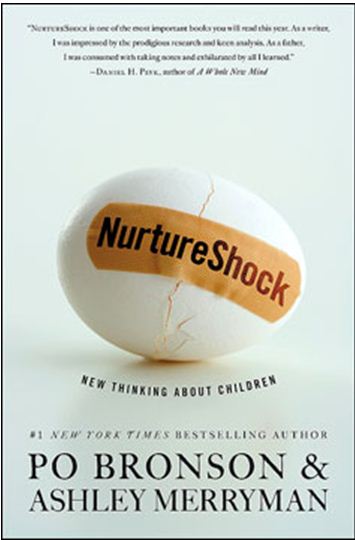
NurtureShock by Po Bronson and Ashley Merryman, a book that is just coming out now, takes several basic notions of parenting, and blows them out of the water with great writing, and compelling scientific research. They also use the word rethink several times, which I applaud.
One of the things that I like about this book is that each chapter is about a very specific thing, such as how we praise a child, why teenagers argue with their parents, the impact of putting kids into highly diverse schools, and the importance of an extra hour of sleep, to name a few. In every case, the subject is introduced, and you will find yourself nodding in agreement, and then they will share with you the research data (which is heavily backed up in the final 100 pages of this book) which is often shocking, as the title suggests, and they then carefully direct you to the why the results of the research make sense and how to change your parenting skills accordingly.
Now my work, which is typically applied to business, is about getting people out of their “how” traps, the ways we all get stuck in our day-to-day ruts, as well as being specific about the outcome of “what” we are doing to make sure we are measuring them the right way. NurtureShock takes for granted that we all want to be the best parents that we can be, with the “outcome” being happy, well-adjusted kids that can leave the nest and chase after what it is that brings happiness and fulfillment to their lives.
Essentially what Bronson and Merryman are saying is that we are in a bunch of “how” traps in our parenting, not because we are stupid or have bad intentions, we just don’t realize that “how” we are doing things actually cause the opposite “outcome” of what we intend, we have simply lacked the evidence to see it so clearly. One of the most glaring examples is the chapter on praise. Lots of people have talked and even joked about how much we over praise our kids these days, but what we have lacked up until this book, was the evidence of the specific damage it causes (aversion to risk taking and trying new things) and how to correct it (greater emphasis on the effort than the outcome). Very actionable clear guidance on how to be better parents. And it’s so well written, you will fly through it.
Shock on.
-Ric

Posted by (0) Comment
When I first saw this article in the paper earlier in the week, I will admit that I didn’t quite get why people, let alone big league venture capitalists, would be excited about Fanbase, who in their words is “the web’s largest almanac of college and pro athletes built by fans.” It’s sort of an intersection of classmates.com and Wikipedia, but with a narrower focus on sports teams.
As I went about my day, I thought more about it, and it started to sink in the Fanbase is not only a really great idea, it is also setting a great example for all sorts of companies.
Since the beginning of time, marketers have tried to understand the various groups or segments of people that buy, or might buy their products. That’s one of the reasons social networking has so much potential, you literally have groups of people opting in to various circles of friends, and when people know, or know of one another, the potential to market into those groups not only allows you to be more targeted, even more importantly with things like referral businesses, you can see causal and correlation behavior based on your marketing investment. In other words you get transparency into whether your marketing efforts directly cause a person, or a group to buy your products or services or at the very least see a correlation, where historically very little of that data has been available to marketers so a lot of marketing has either been guesswork.
One problem with a lot of social networking sites is that just because someone is a “friend” of someone else on a site like Facebook, you don’t really have insight into how well those people know each other, and thus it’s potentially a very loose connection, so it may not really be meaningful that a given person is in a specific network. A site like Classmates.com has some additional benefits where you know that people are the same age, and there’s probably a good chance that they have a lot of common demographic characteristics (like income and personal interests). The downside of a site like classmates is that it’s mostly involuntary. I didn’t pick my classmates, and there are a lot of them that I am not friends with, either in the conventional sense, or in the evolving Facebook definition, so there’s still some risk there in getting to a “pure” segment of customers, if such a thing exists.
Sports teams are great because they are likely to be a much more tight knit group, I would assert that the members of the teams are much more likely to actually like each other, and they probably still behave like a cohesive group. In my case I was on the rowing team in high school and college, and I still keep in touch with both of those groups, I have a picture of my rowing team on my facebook page, I still know all of the names of the people I rowed with and I have kept in touch with more than half of them over the years. So not only is Fanbase going to be a valuable thing to me and my rowing friends, it also puts us in the cross hairs of marketers, because between my schools and the sport, the demographics tend to be very consistent, so my guess is that Fanbase is going to be very successful selling ad space to marketers.
The larger point for companies, and I have talked about this in previous blogs, as well as the Rethink book, the more you can know about your customer and what they value and don’t value, the much easier it is to get more targeted and tailored messaging for them. I expect to see more sites like Fanbase that combine opting in, with groups that have similar demographics, who actually stay in touch with each other, but Fanbase sure seems to have a lot of potential, and if you read the article, it also sounds like a great management team. I am a fan.
-Ric
It’s common, especially on Sunday, that the New York Times will have articles in different sections of the paper that arguably have nothing in common, but in reality, do overlap in some way or another.
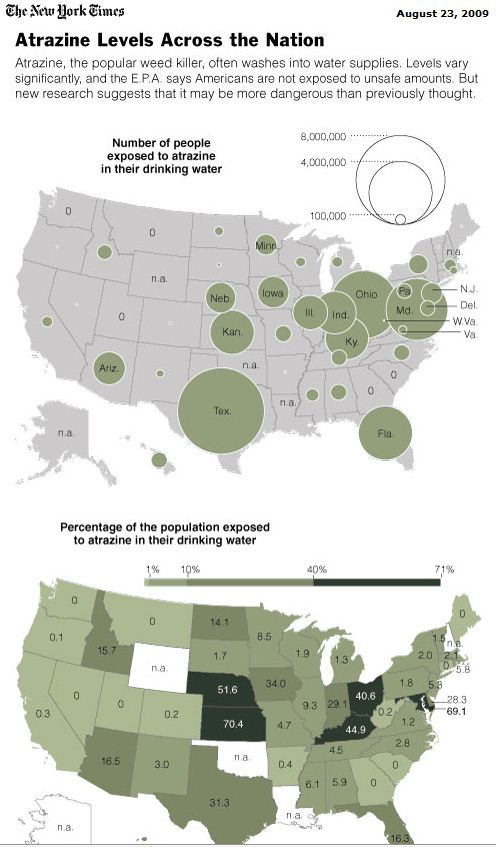
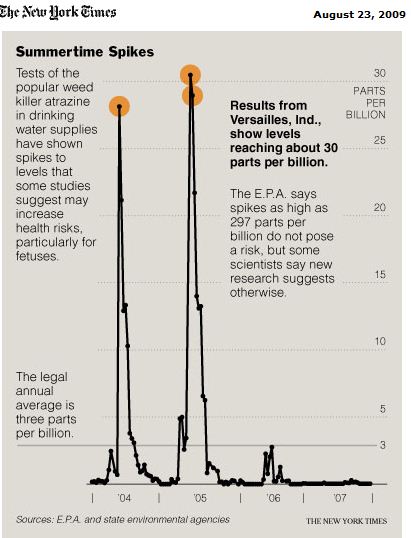
Today on the front page there was this article about the safety of drinking water as a result of pesticides people put on their lawns, and how drinking water is especially at risk in the Summer because of how much lawn care goes in the Summer months. Wonderfully illustrative graphs supplementing very thorough reporting.
Then as I worked my way to the Business section, there was an interesting aticle about how complicated it can be to introduce a new germ killing product because of the tendency of the public not to trust the safety of a product.
The article talked about a company called PureGreen24 and a number of other points of the issue, but what really got my attention was the photograph of the CEO of PureGreen24 essentially drinking the germ killer as a demonstration, very much the sort of thing you would expect to see in an infomercial at 3:00 AM.
Something that I talk about is the importance of a company to really be clear about the value proposition of its products and services, while at the same time being very clear about what is most important to its customers. It’s unsurprising to me that national water safety levels made the front page, and despite the theatrics, I have to give PureGreen24 credit for understanding how critical that issue is to their customer base. Well done.
And well done to the New York Times for continuing to put in these unrelated, but somehow related stories in the same paper. That’s one of the things that’s fun about the Sunday paper.
-Ric
When people say “necessity is the mother of invention” they usually mean that someone invented something new out of a need or desire to make it easier or better. Whether the person needed an easier way to turn on and off lights (a la The Clapper), or help customers get cash whenever they need it (the ATM, automated teller machine), there are lots of examples.
But in recessionary times, when people are laid off, jobs are scarce, so the “necessity” in their case is income. What’s different in cases like those written up in this article, is that in a lot of cases people already have the idea for a product or a business, what they lacked wass the courage or the funding or the confidence to take the chance – and getting laid of provided the motivation, the necessity to get off the couch and do it. People who fall on hard times have their backs against the wall, so they have nothing to lose, so why not take the chance on the idea.
One of the things that I particularly like about some of the stories in the article, is that the people are very practical about the risks they are taking. In the case of Lisa Marie Grillos, she hasn’t gone out to raise venture capital money for some big idea, she has set it up so that every product she sells turns a profit. This isn’t so different from the micro-loan idea you hear about that has been so successful in emerging markets, especially with women. These people are, in many senses giving themselves micro-loans, and with so low risk, if they fail, their failure isn’t catastrophic.
I am not at all surprised to hear that these people are successful. My question is how we can encourage more people to think in micro-loan mentality in terms of pursuing that idea they have and taking small, low risk steps to move them forward. I am confident there are lots and lots of great ideas for great little (and in some cases big businesses) and if we could motivate people to take that chance, even to partner with people to execute on their ideas, we would see a lot of really interesting and useful products, and I think that would go a long way to reviving the message that anything is possible in this country, if you just take a little risk.
It would be very interesting to me to hear your thoughts on how we can motivate more people to pursue their ideas.
-Ric
Talk about a bad collision in the intersection of different advances in technology.
. .
For years I was very skeptical of the restriction of technological devices on airplanes, especially when wireless technology was so much simpler and less pervasive. As the years have marched on, I have taken it as a given that wireless technology is used in so many ways, because of the risk of unintended consequences of one device (like an iPhone or a Gameboy) on a frequency sending a wrong or confusing signal to something like an airplane that can have life or death consequences. I accept that and I think most people, whether or not they think they understand the technology, have come to accept it.
So when I read this article in the paper this morning, I was shocked. This guy Andre Melnikov called to complain that his stove was turning itself on and off, and his landlord was clearly skeptical that this brand new stove would do such a thing. So when he retraced his steps, he remembered that he got a cell phone call just before it happened. Somewhat improbably, he connected the two together and was able to recreate the incident repeatedly. When his cell phone rang, it triggered the oven to be switched on to “HIGH” and not only that, because other people in his apartment complex had also just gotten the same model of this new stove, his phone was also turning their ovens on when his phone rang. Talk about a huge danger.
The fact that it’s a Maytag stove and a Sony phone are, from where I sit, immaterial to the larger “how” trap many manufacturers are in.
It used to be that when you tested your product for safety and basic functionality, you could test it alone and safely assume no “outside” influences would alter the way it functions. In the world of technology this loosely aligns with the definition of a string test where you control everything in the environment that is “strung” together within an enclosed, knowable set of conditions. It’s when you open the product up to a larger universe of things you don’t control, often called the “integration” test, that you have to prepare for almost anything, because you don’t control what could come at you. Manufacturers now need to open their minds to what kinds of things can influence their increasingly technologically advanced products.
So two things need to happen:
1) There needs to be much greater transparency to radio frequencies and who is using which spectra for what (interfering with your kid’s baby monitor is one thing, potentially burning down your house, or your neighbor’s house, is something vastly different)
2) Testing standards need to be revisited. Some conditions that were unrealistic to test ten years ago need to be added to the tests, largely expanding to an “integration” test notion from the simpler “string” test notion.
I am amazed that they figured this out and that no one’s house burned down (as far as we know) as a result of this. I do think this should have been a candidate for the front page instead of being buried on page 26. This is serious stuff, and probably the tip of the iceberg in terms of unintended collisions of technology.
-Ric
I decided to make an important point using a story that’s been all over the news this week.
In the world track and field championships in Berlin, the women’s 800 meter dash was won by Caster Semenya of South Africa. There’s no question about that, just as in most sporting competitions, especially with advanced technology, there’s almost never any question about who wins and loses, there is a “right” answer, and sometimes it’s a tie, not often, but sometimes.
The reason this story made news, initially, was because some have asked whether Caster Semenya is a woman. But that’s not why it’s staying in the news. As this article explains, the real reason this story persists, is that it turns out that in about 1% of the population, it can be very difficult to reach a conclusion, despite hormonal, chromosonal, and even physical appearance tests. It makes me very sad that this athlete is making world news because their gender is so hard to determine, and I sincerely hope that she proves to be a woman (and that people feel comfortable with whatever standard is used) and that she can keep the gold medal she was awarded on Thursday.
There are other cases in sports where there isn’t a clear and obvious answer, even with technology. Did the tennis ball going 110 miles per hour graze the in/out line when it bounced? Did the football player have possession of the ball before it was knocked out of his hands (making the difference between an incomplete pass and a fumble).
Math problems have right and wrong answers, and when I was in school you could look in the back of the book to immediately learn whether you got the right answer to the math problem. English essays, by contrast required some waiting, and even when the teacher assigned a grade, you couldn’t really go back to them and say “you’re wrong, this is an A paper, not an A minus paper.”
The same is true in business, but that can be both good news and bad news. Something like sales is in the category of right and wrong answers for most businesses – how much revenue did we bring in this month? We wanted to sell 15 more units this month than we sold last month, yes, or no, did that happen? But how do you know if marketing is really helping sales, for example? In some cases that’s really hard to measure. Even when people try to quantify something such as customer satisfaction with a survey, how do you know you are asking the right questions, or if there are right and wrong questions?
I often see people write down goals along the lines of “Better revenue” (I have not seen that exact one, but it works for the example) and I will ask what “better” means, and the person will often say something like “more”, and then I will follow with an array of questions, how much more? is all revenue the same? are there categories of revenue that are easier for us to get (lower cost of sales)? and so on to help them get more specific so they can have clear answers that can make it easier to make decisions about when things are going well, or not so well.
My point is to be as quantitative as you can in setting your goals, such as 24% increase in revenue, and be as specific about it as you can (so it might be a 35% increase in North America, 15% increase in Asia, and 12% increase in Europe that makes up that overall 24%). More importantly, attach metrics for what causes an increase in revenue. a 24% increase in revenue coming from an 11% increase in marketing spending is very different from coming off a 35% increase in marketing spend. Of course this applies to lots of areas of work, not just sales and marketing.
Be specific where you can, attach related metrics to one another to track the causes of changes in performance, and finally, keep asking if you have the right metrics (do you have confidence in your customer satisfaction survey questions, and why?).
-Ric
Posted by (0) Comment
If you are a curious person like me, you may have wondered how a restaurant reviewer does their job.
I have heard all kinds of stories about reviewers wearing disguises so as not to be recognized, and in some cases, like the former food critic for the New York Times, Frank Bruni his appearance was a closely guarded secret. Now that he has left that job, he has taken his mask off, and there have been lots of stories about how shocked restaurant owners are to know “that guy” is Frank Bruni.
Bruni recently published this article in the paper that described how he would go about reviewing a restaurant.
One of the things I have wondered is if a critic samples a few dishes in a couple of visits and that’s what goes into a review. They can’t possibly eat everything on the menu, right? Wrong, at least in Bruni’s case.
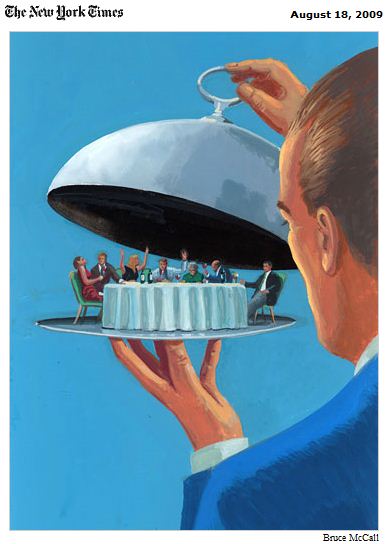
Bruni was more methodical and sampled absolutely everything on the menu in two or three visits. How? It turns out Bruni had a group of accomplices he would invite to the meals and their job was to work with him and as a group get through everything, and everyone had to share a specific amount of their food with everyone else (if there were four at the table, each person could have a quarter of each portion). Part of what makes the article so fun is the way Bruni talks about the different personality types, who is good at sharing, who isn’t who always wants steak, and so forth.
Even though Bruni “assignsed” dishes to people to ensure completeness, he observes how people started to view the dishes assigned to them as “their” pork, or “their” risotto” when the assignments were typically randomly assigned.
But as a simple point when you have one expert that has to cover a lot of ground, this sort of sampling and getting a team of others to get through it all makes a lot of sense, and it’s very thorough, so the restaurant being reviewed doesn’t have to worry that the reviewer didn’t bother to try their signature appetizer or entree.
Food for thought.
-Ric
Most people have heard the phrase “have a little hair of the dog that bit you” or some variation of it. Not as many people know the origin of the phrase. Long ago in the world of medicine it was believed that when a person had been bitten by a rabid dog, the step to take to prevent from getting rabies was for the “patient” to place a hair of the dog that bit them on the wound. Really. Of course one of the flaws of this approach (beyond the fact that it did not work) was the need to locate the dog and get a hair without also being bitten.
Thankfully the expression has outlived the bogus treatment, but I couldn’t help but chuckle when I read this article in the paper today.
It turns out that researchers studying how to cure heroin addiction have found that instead of giving addicts methadone (which I learned is the prevailing method of treatment), addicts given diacetylmorphine, the active ingredient in heroin, had a higher success rate than methadone. So now the message is that prescription heroin is a better cure for heroin addiction than methadone.
This isn’t quite in the same category of how to put out a forest fire (you start a series of small fires in the path of a spreading fire so that when the larger fire gets there, there’s nothing for it to burn, so it is a lot easier to extinguish), but in the category of rethinking how to solve problems, sometimes adding additional measured doses of the same problem makes it easier to solve the larger problem.
Prescription heroin is not quite the same image of chasing down some mangy old rabid dug, but at least another way to keep that old expression alive.
-Ric
What was the sexual revolution of the 1960′s? While I wasn’t old enough to really be aware of it, at its essence it changed the definition and etiquette of who it was OK to have sex with, right? There’s a lot more to it than that, but that was one of the most basic and fundamental things that changed in that era, and after that shift happened, the definition and etiquette have continue to evolve and different age groups and social groups have their own ideas, but the sexual revolution, which was also really a social revolution transformed culture.
When people talk about Facebook and myspace and Twitter and other social networking sites, a lot of people talk about how those sites will monetize social networking and those kinds of things in a more forward looking fashion.
Well I am here to tell you a second sexual, or at the very least a second social revolution, has already happened, and it’s as simple as what happened in the ’60s.
Facebook has changed the actual definition of the word “friend” for most people under 40, and a lot of people over 40. By fundamentally changing the definition of the word friend, people are shifting their ideas about privacy and communications. It has already happened. What we don’t yet know is how that will transform our social work environments when 20-somethings have one set of standards and definitions of what is OK, communicating with a boss over 50 with a very different set of definitions and expectations of what’s OK, it’s going to be the 60′s all over again, though probably a lot less psychedelic.
There’s a new movie coming out next month called We Live In Public, it already won the best documentary at Sundance this year, and it’s in the running for the Oscar. I have seen it and I really think it captures some of the good, as well as the dark side of this revolution. It’s such a watershed moment in our culture, I think this movie is going to wake everyone up to what has already happened and it’s going to force people to rethink where we are all headed.
The revolution has already happened. Now we have to see what’s next.
-Ric
Two Sundays ago, the headline of the New York Times was “Climate Change Seen as Threat to US Security” in this article by John Broder. While I stopped short of checking the date to see if it was April first. It sounded like something more fitting for the tabloids, or at the very least page 18 instead of such an alarmist headline. Here’s the first paragraph:
“The changing global climate will pose profound strategic challenges to the United States in coming decades, raising the prospect of military intervention to deal with the effects of violent storms, drought, mass migration and pandemics, military and intelligence analysts say.”
So it got me thinking, with unemployment where it is, and the Iraq war winding down, we aren’t going to send all of the Iraq troops to Afghanistan, maybe declaring a war on global warming is the only way to continue to maintain, or grow, military spending. The more practical side of me took some comfort in the fact that some folks in Washington really have their finger on the pulse of global warming and they see clearly on what is needed to prepare for it.
That comfort was blown out of the water when I read an article in the paper today (click here) describing that 31 year-old Joseph Mahmoud Dibee, who was arrested for ecoterrorism (arson and destruction of property) on behalf of the group known as the Earth Liberation Front, or ELF, in January 2006 still has a valid pilot license. How is that possible?
I remember back on September 11, 2001, back when we were still pretty naive about the risks of terrorism, we knew that some of the top terror suspects were in the country and we could have cross referenced several data bases to track them down. Excusable then, perhaps, but that was eight years ago and we still haven’t cross-referenced the FAA data base with the F.B.I.’s most wanted list? Incredible.
Now, I will grant you when it comes to high stakes terror, if someone commits a crime in an airplane, it’s not going to matter whether the person was, or wasn’t flying with a valid license. That’s not my point. My point is that if these seemingly simple and obvious data cross reference checks aren’t happening, what else isn’t happening? How smart are we really about what the real risks are and where they are.
I don’t think there’s any need for a witch hunt, but really, someone in D.C. ought to really take a look at cross-referencing some of the criminal data bases with other key sources so our comfort level can go up a few notches when it comes to national security.
-Ric